"There is no Move Action in Cybercore. Every Action includes movement. What matters is where you end up."
The Grid
Cybercore uses a hex grid for tactical combat and structured exploration. 1 hex = 2 metres. Hexes eliminate the diagonal movement problem entirely; every adjacent hex is the same distance, so movement, range, and area effects just work without special rules.
If your table prefers a square grid, that's fine too. Use the same 1 square = 2 metres scale. For diagonal movement on a square grid, use the 1-2-1 rule: the first diagonal step costs 1 square of movement, the second costs 2, the third costs 1, and so on alternating. This averages out to a more accurate distance than treating diagonals as free.
Why hexes? On a square grid, moving diagonally covers ~2.8 metres per square instead of 2. Over a few squares that's close enough. Over 20 squares, a rifle shot, a charge across a cargo bay, the error adds up. Hexes don't have this problem. Six directions, all equal, no arguments about whether the grenade blast reaches that corner. If your group has square grid maps and doesn't want to switch, the 1-2-1 rule keeps things honest.
For range bands and weapon distances, see Range and Cover. For AoE templates (blast, cone, line, zone), see Areas & Distance.
Movement Basics
There is no dedicated Move Action. Movement is built into every Action, but each Action you spend is a choice between two modes:
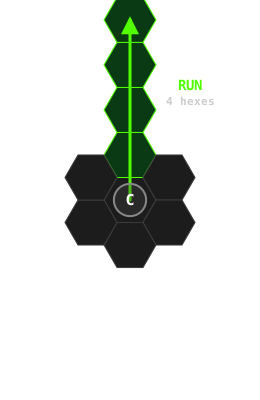
- Run, Spend the whole Action on movement. Move up to your full Speed in hexes. No other action this turn (defence is passive and still works, you can dodge, take cover, soak with AF).
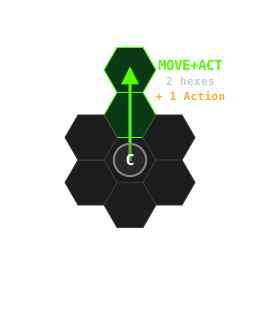
- Move and Act; Spend the Action on a normal action (attack, skill check, use an item, reload, hack, whatever). Move up to half your Speed (round up, minimum 1 hex) before or after the action, your choice.
You must complete all movement either before or after the action; you cannot split it around the action unless a feat or ability says otherwise (such as Nimble).
These rules apply to all combatants; players and creatures alike. A creature with Speed 3 can Move-and-Act (1 hex + attack) or Run (3 hexes, no attack), same as a player.
Your base Speed is derived from your Mass:
| Mass | Speed | Half Speed (Move and Act) |
|---|---|---|
| 1 | 6 | 3 |
| 2 | 5 | 3 |
| 3 (Human) | 4 | 2 |
| 4 | 3 | 2 |
| 5 | 2 | 1 |
| 6+ | 2 (minimum) | 1 |
Speed = 7 - Mass (minimum 2 for base Mass, minimum 1 if Mass is increased by feats). See Mass and Speed for the full rules.
Every Action is a fork in the road: all-out movement or act while moving. A Tier 1 character with 1 Free Action either covers their full Speed in hexes (Run) or fires a weapon and shifts half their Speed (Move and Act). Burning Energy for additional Actions means more of the same; each extra Action gets its own Run-or-Act decision. A Tier 2 character with 2 Free Actions could Run + Shoot (full Speed + half = 1.5× Speed of ground covered, with one attack), or Run + Run for double Speed when the squad just needs to be somewhere else, now. A Tier 3 character with 3 Free Actions gets the full Run + Shoot + Reload spread without spending any Energy. Your hands are free during a Run, which is useful for carrying things, opening doors as you pass, or making rude gestures at whoever you're outpacing.
Run · Speed 4
Move and Act · Speed 4
Terrain Types
Not all ground is created equal. Terrain affects how fast you move and what you can do while moving.
Open Terrain
Standard ground. Corridors, decks, paved surfaces, open cargo bays. Move at full Speed. No modifiers.
Difficult Terrain
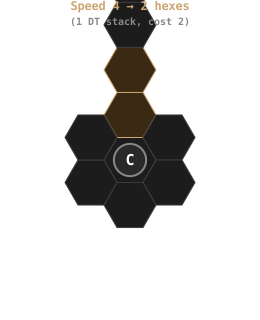
Rubble, loose wiring, shallow water, thick undergrowth, unstable flooring, debris fields, ice, mud, sand, low-gravity dust. Each Difficult Terrain effect adds +1 hex to the cost of entering an affected hex. A single effect doubles the cost (1 base + 1 = 2 hexes per hex moved). A character with Speed 4 can move 4 hexes on open terrain, but only 2 hexes through Difficult Terrain.
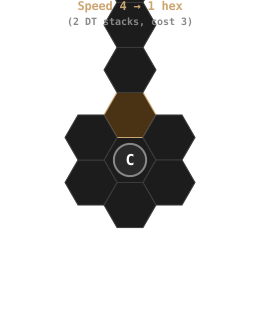
Difficult Terrain stacks. Multiple Difficult Terrain effects in the same hex each add +1, this is the Cybercore default (everything stacks unless explicitly stated otherwise). Shallow water across a rubble field costs 3 hexes per hex moved. Knee-deep mud across a debris-strewn floor with overhead sparking wires costs 4. Minimum 1 hex of movement per Action, no terrain stack reduces you below the ability to take one step.
If your path crosses both open and Difficult hexes, count each hex by its own cost.
Difficult terrain does not affect attacks, skill checks, or other actions. It only affects movement distance. You fight just as well standing in rubble; you just can't get there as fast.
1 DT stack · cost 2
2 DT stacks · cost 3
Hazardous Terrain
Terrain that damages you for being in it: active fire, electrified flooring, toxic spills, radioactive zones, decompressing corridors. You take the listed damage for each hex you enter or start your turn in.
Hazardous terrain does not automatically slow you down; you can sprint through a burning corridor at full Speed if you're willing to pay the price. However, if the GM designates an area as Hazardous Difficult Terrain, it costs double movement AND deals damage. A corridor on fire might be just Hazardous (full Speed, take Hits). A corridor on fire with collapsed ceiling panels is Hazardous Difficult Terrain (half Speed, take Hits).
Hazardous terrain should be obvious in the description and called out by the GM with an approximate damage type and amount.
The overhead lighting is dead. What's left is the emergency strip running along the baseboard, a thin red line that flickers every time the station's power grid hiccups, which is often. The corridor ahead is thirty metres of iron lattice flooring suspended over an exposed pipe subbasement. Through the gaps in the metalwork you can see it: waist-deep coolant, pale green, churning slowly in the dark below. The ruptured feeder pipes are up high on the left wall, three of them, split clean open, venting pressurised coolant in flat white sheets across the walkway. The spray hits the lattice and drains through, but not fast enough. There's a film of it on the steel. It's steaming. The emergency strip goes dark for a full second, then comes back dimmer than before.
"Corridor 7-C is Hazardous Terrain, 1 Hit Chemical per hex from the coolant spray. The lattice flooring is bolted to the cross-beams and it's holding. For now. Full Speed. Don't stop, don't breathe it in, and if your boots start dissolving you're already past the point where slowing down helps. The subbasement below is Impassable, waist-deep industrial coolant, no exit, and the lattice hatch at the far end is the only way forward."
Impassable Terrain
Walls, sealed bulkheads, solid rock, force fields, vacuum (without a suit), Pool of industrial acid. You cannot move through impassable terrain. Find another way around, or make your own way through; Breachers and Riggers exist for a reason.
Climbing
Moving vertically; ladders, walls, cliff faces, hull exteriors.
Default climbing speed: half your Speed (round up, minimum 1 hex). Climbing requires at least one free hand. While climbing, you suffer Disadvantage on all actions that require two hands.
| Surface | Requirement |
|---|---|
| Ladder / handholds | No check required. Half Speed. One free hand. |
| Rough wall / hull plating | Movement - Athletics check vs Mission TL. Half Speed. Both hands. |
| Smooth wall / glass | Movement - Athletics check vs Hard Mission TL. Half Speed. Requires climbing gear or mag-clamps. |
| Ceiling | Requires mag-clamps, grav boots, or zero-G. |
Falling: If you fail a climbing check, you fall. Take 1 Hit per 2 hexes (4 metres) fallen, plus land Prone. If the fall exceeds 10 hexes (20 metres), the damage doubles to 2 Hits per 2 hexes.
Origin feats can modify climbing: Rodi Tunnel Runner, Karani Canopy Runner, Veth Climbing Pads, and Silicoid Burrow Speed all interact with vertical movement. See your origin page for details.
Wading
Moving on foot through standing or flowing water; shallow rivers, flooded corridors, coolant pools, surf, drainage tunnels.
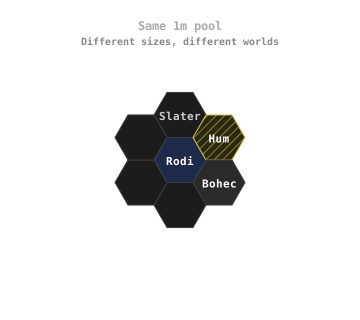
Wading depth is judged against the wader's Size. A pool that submerges a Rodi reaches a Slater's knee. The GM calls the absolute depth in metres; each character checks their own Size band to see which tier of effect applies to them. Size is a useful proxy for height and girth; heavier origins occupy more cubic space, so currents push them around less but they displace more water when submerged.
Size → Depth Table
Cross-reference the GM's depth call against your creature Size to find your tier.
| Creature Size | Mass | Knee | Waist | Chest | Over Head |
|---|---|---|---|---|---|
| Tiny | 1 | 0.1m | 0.2m | 0.4m | 0.5m+ |
| Small | 2 | 0.2m | 0.5m | 0.8m | 1.0m+ |
| Medium | 3–4 | 0.4m | 1.0m | 1.3m | 1.7m+ |
| Large | 5–7 | 0.7m | 1.5m | 2.0m | 2.5m+ |
| Huge | 8+ | 1.0m | 2.0m | 2.8m | 3.5m+ |
Worked example. The GM says: "The corridor is flooded, about 1 metre deep, brackish, mild current." For the squad: the Rodi (Small, Mass 2) is over head, she's swimming. The Human medic (Medium, Mass 3) is waist-deep. The Bohec Soldier (Large, Mass 5) is knee-deep. The Slater (Huge, Mass 8) is barely shin-deep. One depth, four different experiences.
Same pool, four sizes
Wading Effects by Tier
Wading depth applies stacking Difficult Terrain; knee is the "shallow water" entry from the terrain list (1 stack), and each deeper tier adds another. This stacks normally with any other terrain in the same hex (riverbed clutter, sparking wires, debris).
| Depth Tier | Difficult Terrain Stacks | Hex Cost | Extra Effect |
|---|---|---|---|
| Ankle / shin | 0 | 1 hex per hex | None. |
| Knee | 1 stack | 2 hexes per hex | Hands free. |
| Waist | 2 stacks | 3 hexes per hex | Both hands needed for balance; Disadvantage on any action requiring two free hands (rifles, two-handed melee, climbing gear). |
| Chest | 3 stacks | 4 hexes per hex | Movement - Athletics check vs Mission TL each round or be Hindered(1) until you regain footing or reach shallower water. |
| Over head | , | , | Switch to Swimming rules. |
Minimum 1 hex of movement per Action. A Slater (Speed 2) chest-deep in water has cost 4 per hex; they can still move 1 hex per Action. They will be slow. They will be cold. They will be cold and slow, but they will move.
Current While Wading
If the water has a current, waders are subject to the same sweep distances as swimmers. Roll Movement - Athletics vs Mission TL at the start of each round you remain in moving water:
- Failure in a rough current: swept 2 hexes downstream.
- Failure in a strong current: swept 3 hexes downstream.
- Failure in a torrent: swept 4 hexes downstream and knocked off your feet; treated as Swimming until you regain footing on a subsequent turn's Athletics check.
Size cuts both ways in current. Larger Size grants a Boon(1) per Size step above Medium to resist being swept while wading (Large = Boon(1), Huge = Boon(2)); more mass plants better. But once over your head, that same Mass works against you (see Swimming).
Riverbed Footing
Wet stone, river silt, loose gravel, mud, kelp, debris, submerged wreckage; each counts as one additional Difficult Terrain stack in the affected hex (same rule as any other terrain stack, see Difficult Terrain).
- Knee-deep (1 stack) over loose gravel (1 stack) = 2 stacks, 3 hexes per hex moved.
- Waist-deep (2 stacks) over submerged wreckage (1 stack) = 3 stacks, 4 hexes per hex moved.
- Chest-deep (3 stacks) over wreckage AND silt (2 stacks) = 5 stacks, 6 hexes per hex moved; minimum-1-hex rule still applies, so you can crawl one hex per Action and that's it.
If the depth is already Over Head, riverbed footing only matters when you're trying to regain footing; apply Disadvantage to the Athletics check to stand back up.
Current Severity Guide
GM reference for picking a current tier:
| Tier | Examples | Sweep on Fail |
|---|---|---|
| Rough | Wake of a passing craft, choppy harbour, river after rain | 2 hexes |
| Strong | Swollen river, tidal race, coolant outflow under pressure | 3 hexes |
| Torrent | Flood surge, broken dam, white-water rapids, ship breach venting | 4 hexes + knocked off feet |
Swimming
Moving through water or other liquid.
Default swimming speed: half your Speed (round up, minimum 1 hex). Swimming requires both arms free unless you have a feat or equipment that says otherwise.
| Condition | Effect |
|---|---|
| Calm water | Half Speed. No check required. |
| Rough water / current | Half Speed. Movement - Athletics check vs Mission TL each round or be swept 2 hexes in the current direction (3 in strong current, 4 in a torrent; GM's call). |
| Armoured swimming | Speed quartered (round up, minimum 1). Armour with Mass 4+ requires a Movement - Athletics check vs Hard Mission TL each round or sink 1 hex. |
| Underwater (no suit) | Can hold breath for Fortitude rounds. After that, gain 1 Exhaustion per round. |
Powered armour sinks. Exoskeletons sink. If you go into the water in a hardsuit, you are walking on the bottom at Speed 1 and hoping your air supply holds. This is not a design flaw. It's a feature for whoever pushed you in.
Zero-Gravity Movement
No gravity, no floor, no "down." Welcome to the void.
In zero-G, movement works differently. You cannot walk; you push off surfaces, use handholds, or rely on equipment (mag-boots, jetpacks, manoeuvring thrusters).
| Method | Speed | Notes |
|---|---|---|
| Push-off | Half Speed | Push off a surface within reach. Move in a straight line. Cannot change direction until you reach another surface. |
| Handholds / guide rails | Full Speed | Standard movement along prepared zero-G corridors. Most stations and ships have these. |
| Mag-boots | Half Speed | Walk on any ferrous surface. Treated as normal movement but at half Speed. Cannot jump. |
| Jetpack / manoeuvring thrusters | Full Speed (or as listed) | Three-dimensional movement. See Movement - Flying / 0-G for tricks and manoeuvres. |
| Free float | Drift at last push-off speed | No control. You continue in a straight line until you hit something or someone catches you. |
Newton's Third Law is not optional. Firing a weapon in zero-G applies thrust in the opposite direction. Small weapons: negligible. Medium weapons: 1 hex drift per shot. Large weapons: 2 hexes drift per shot, or you need to be braced against a surface. Recoil compensation training (weapon tricks) can reduce or eliminate this.
Vertical Movement Summary
| Movement Type | Default Speed | Check Required | Notes |
|---|---|---|---|
| Climbing (ladder) | Half Speed | No | One free hand |
| Climbing (rough wall) | Half Speed | Athletics vs Mission TL | Both hands |
| Climbing (smooth wall) | Half Speed | Athletics vs Hard Mission TL | Requires gear |
| Wading (knee) | 1 stack Difficult Terrain (2 hex/hex) | No | Shallow water = Difficult Terrain |
| Wading (waist) | 2 stacks (3 hex/hex) | No | Disadvantage on two-handed actions |
| Wading (chest) | 3 stacks (4 hex/hex) | Athletics vs Mission TL/round | Risk of Hindered; min 1 hex/Action |
| Swimming (calm) | Half Speed | No | Both arms free |
| Swimming (rough) | Half Speed | Athletics vs Mission TL/round | Risk of sweep |
| Swimming (armoured) | Quarter Speed | Athletics vs Hard Mission TL/round | Risk of sinking |
| Zero-G (push-off) | Half Speed | No | Straight line only |
| Zero-G (handholds) | Full Speed | No | Prepared corridors |
| Zero-G (mag-boots) | Half Speed | No | Ferrous surfaces only |
| Zero-G (jetpack) | Full Speed | Skill for tricks | 3D movement |
| Falling | Instant | ; | 1 Hit per 2 hexes, Prone |
Forced Movement
Some abilities push, pull, or throw creatures. Forced movement:
- Does not trigger abilities that key off voluntary movement; being shoved isn't moving under your own power
- Ignores difficult terrain; you're being shoved, not walking
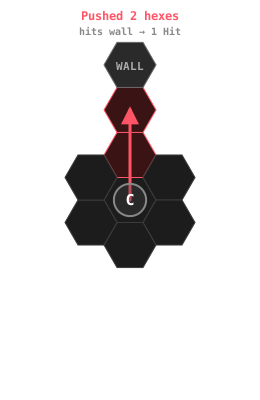
- Stops if you hit an impassable surface; and take 1 Hit per 2 hexes of remaining forced movement (you hit a wall)
- Can move you through hazardous terrain; you take the listed damage for each hex
Pushed into a wall
Movement Skills
For advanced movement techniques, parkour, zero-G acrobatics, vehicle piloting, see the Movement skill category:
Related Systems
- Action Economy; Run vs Move-and-Act on every Action
- Areas & Distance; AoE templates that occupy the grid
- Cover & Positioning; range bands, cover, flanking & crossfire
- Grappling; when movement is contested by another creature
- Travel; movement during Sweeps (between encounters)